022. Maximum Angle
In right triangle with , , and , there is a point moving along . Let be the maximum value of with respect to the midpoint of . Find the value of .
The key is to draw the auxiliary circle. Let be the center of the circle passing through points and and tangent to .
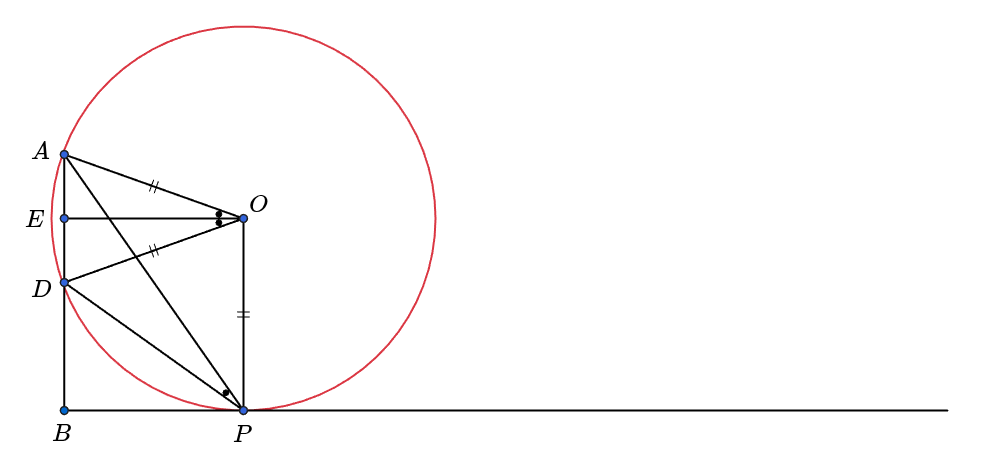
Let be the midpoint of , and let lie on the point where the circle is tangent to . The foot of the perpendicular line dropped from the center of the circle onto the chord bisects the chord, so . Since , is a rectangle. Therefore, the radius of circle is , so .
Then, is the maximum value. As shown in the figure below, suppose point does not lie on circle . Let be the point where a line passing through and perpendicular to intersects circle . Then, since point lies outside circle , .
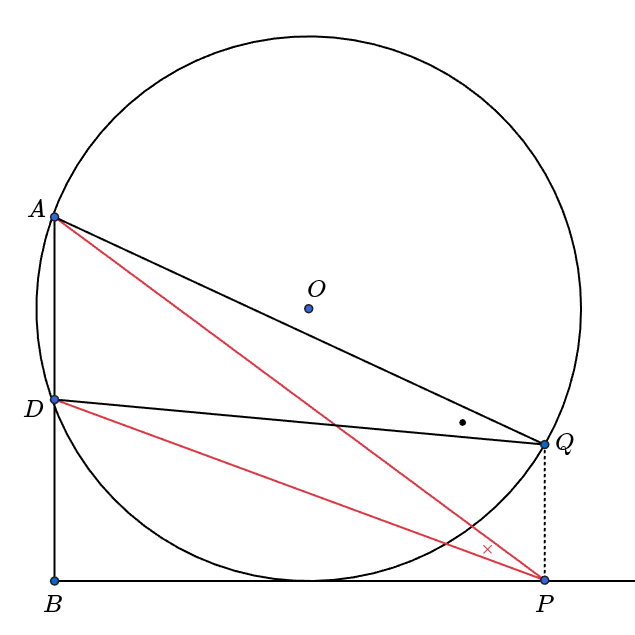
That is, when point lies on circle , is maximized. Therefore, .